Hydrogeology of Angola: Difference between revisions
No edit summary |
No edit summary |
||
| Line 1: | Line 1: | ||
[[Overview of Africa Groundwater Atlas | Africa Groundwater Atlas]] >> [[Hydrogeology by country | Hydrogeology by country]] >> Hydrogeology of Angola | [[Overview of Africa Groundwater Atlas | Africa Groundwater Atlas]] >> [[Hydrogeology by country | Hydrogeology by country]] >> Hydrogeology of Angola | ||
'''Most of the textual information on this page was taken from the chapter on Angola in the report [http://www.bgs.ac.uk/africagroundwateratlas/fulldetails.cfm?id=AGLA060001 ‘Groundwater in Eastern, Central and Southern Africa’] (UN 1989).This information is outdated. If you have more recent information on the hydrogeology of Angola, please get in touch.''' | |||
== | |||
==Compilers== | |||
'''Dr Kirsty Upton''' and '''Brighid Ó Dochartaigh''', British Geological Survey, UK | |||
==Geographical Setting== | |||
[[File:Angola_Political.png | right | frame | Map of Angola (For more information on the datasets used in the map see the [[Geography | geography resources section]])]] | |||
===General=== | ===General=== | ||
Angola is in central-southern Africa. | |||
{| class = "wikitable" | |||
|- | |||
|Estimated Population in 2013* || 21,471,618 | |||
|- | |||
|Rural Population (% of total) (2013)* || 57.5% | |||
|- | |||
|Total Surface Area* || 1,246,700 sq km | |||
|- | |||
|Agricultural Land (% of total area) (2012)* || 47.5% | |||
|- | |||
|Capital City || Luanda | |||
|- | |||
|Region || Central Africa | |||
|- | |||
|Border Countries || Namibia, the Democratic Republic of the Congo, Zambia | |||
|- | |||
|Annual Freshwater Withdrawal (2013)* || 708.8 Million cubic metres | |||
|- | |||
|Annual Freshwater Withdrawal for Agriculture (2013)* || 20.8% | |||
|- | |||
|Annual Freshwater Withdrawal for Domestic Use (2013)* || 45.3% | |||
|- | |||
|Annual Freshwater Withdrawal for Industry (2013)* || 33.9% | |||
|- | |||
|Rural Population with Access to Improved Water Source (2012)* || 34.3% | |||
|- | |||
|Urban Population with Access to Improved Water Source (2012)* || 67.6% | |||
|} | |||
<nowiki>*</nowiki> Source: World Bank | |||
===Climate=== | |||
<gallery widths="375px" heights=365px mode=nolines> | |||
File:Angola_ClimateZones.png |Koppen Geiger Climate Zones | |||
File:Angola_ClimatePrecip.png |Average Annual Precipitation | |||
File:Angola_ClimateTemp.png |Average Temperature | |||
</gallery> | |||
[[File:Angola_pre_Monthly.png| 255x124px| Average monthly precipitation for Angola showing minimum and maximum (light blue), 25th and 75th percentile (blue), and median (dark blue) rainfall]] [[File:Angola_tmp_Monthly.png| 255x124px| Average monthly temperature for Angola showing minimum and maximum (orange), 25th and 75th percentile (red), and median (black) temperature]] [[File:Angola_pre_Qts.png | 255x124px | Quarterly precipitation over the period 1950-2012]] [[File:Angola_pre_Mts.png|255x124px | Monthly precipitation (blue) over the period 2000-2012 compared with the long term monthly average (red)]] | |||
For further detail on the climate datasets used see the [[Climate | climate resources section]]. | |||
=== | ===Surface water=== | ||
{| | |||
|- | |||
| | |||
| [[File:Angola_Hydrology.png | frame | Surface Water Map of Angola (For more information on the datasets used in the map see the [[Surface water | surface water resources section]])]] | |||
|} | |||
===[[Land cover]]=== | ===Soil=== | ||
{| | |||
|- | |||
| [[File:Angola_soil.png | frame | Soil Map of Angola (For map key and more information on the datasets used in the map see the [[Soil | soil resources section]])]] | |||
| | |||
|} | |||
===Land cover=== | |||
{| | |||
|- | |||
| | |||
| [[File:Angola_LandCover.png | frame | Land Cover Map of Angola (For map key and more information on the datasets used in the map see the [[Land cover | land cover resources section]])]] | |||
|} | |||
==Geology== | |||
This section provides a summary of the geology of Angola. More information is available in the report [ADD LINK UN] (1988) (see References section, below). | |||
The geology map shows a simplified version of the geology at a national scale (see [[Geology | the Geology resources page]] for more details). | |||
[[File:Angola_Geology.png | right]] | |||
{| class = "wikitable" | |||
|+ Geological Environments | |||
|Key Formations||Period||Lithology | |||
|- | |||
!colspan="4"|Geological Environment 1 | |||
|- | |||
|Name of formation1 | |||
||Time period | |||
||Description | |||
|- | |||
| | |||
|| | |||
|| | |||
|- | |||
!colspan="4"| Geological Environment 2 | |||
|- | |||
| | |||
|| | |||
|| | |||
|- | |||
| | |||
|| | |||
|| | |||
|- | |||
!colspan="4"| Geological Environment 3 | |||
|- | |||
| | |||
|| | |||
|| | |||
|- | |||
| | |||
|| | |||
|| | |||
|} | |||
==Hydrogeology== | ==Hydrogeology== | ||
===[[ | This section provides a summary of the hydrogeology of the main aquifers in Angola. More information is available in the report [ADD LINK UN] (1988) (see References section, below). | ||
The hydrogeology map shows a simplified version of the type and productivity of the main aquifers at a national scale (see [[Aquifer properties| the Aquifer properties resource page]] for more details). | |||
[[File:Angola_Hydrogeology.png]] [[File: Hydrogeology_Key.png | 500x195px]] | |||
====Unconsolidated==== | |||
{| class = "wikitable" | |||
|Named Aquifers||Period||General Description||Water quality | |||
|- | |||
| | |||
|| | |||
|| | |||
|| | |||
|} | |||
==== Sedimentary - Intergranular Flow==== | |||
{| class = "wikitable" | |||
|Named Aquifers||Period||General Description||Water quality | |||
|- | |||
| | |||
|| | |||
|| | |||
|| | |||
|} | |||
==== Sedimentary - Intergranular & Fracture Flow==== | |||
{| class = "wikitable" | |||
|Named Aquifers||Period||General Description||Water quality | |||
|- | |||
| | |||
|| | |||
|| | |||
|| | |||
|} | |||
==== Sedimentary - Fracture Flow==== | |||
{| class = "wikitable" | |||
|Named Aquifers||Period||General Description||Water quality | |||
|- | |||
| | |||
|| | |||
|| | |||
|| | |||
|} | |||
====Basement==== | |||
{| class = "wikitable" | |||
|Named Aquifers||Period||General Description||Water quality | |||
|- | |||
| | |||
|| | |||
|| | |||
|| | |||
|} | |||
==Groundwater Status== | |||
===Groundwater quantity=== | |||
===Groundwater quality=== | |||
==Groundwater use and management== | |||
=== Groundwater use=== | |||
=== Groundwater management=== | |||
===Groundwater monitoring=== | |||
=== Transboundary aquifers=== | |||
For further information about transboundary aquifers, please see the [[Transboundary aquifers | Transboundary aquifers resources page]] | |||
==References== | |||
The following references provide more information on the geology and hydrogeology of Angola. | |||
These, and others, can be accessed through the [http://www.bgs.ac.uk/africagroundwateratlas/searchResults.cfm?title_search=&author_search=&category_search=&country_search=AO&placeboolean=AND&singlecountry=1 Africa Groundwater Literature Archive] | |||
= | United Nations. 1989. [http://www.bgs.ac.uk/africagroundwateratlas/fulldetails.cfm?id=AGLA060001 Groundwater in Eastern, Central and Southern Africa: Angola]. United Nations Department of Technical Cooperation for Development, Natural Resources/Water Series No.19, ST/TCD/6. | ||
==Return to the index pages== | |||
[[Overview of Africa Groundwater Atlas | Africa Groundwater Atlas]] >> [[Hydrogeology by country | Hydrogeology by country]] >> Hydrogeology of Angola | |||
Revision as of 17:34, 16 September 2015
Africa Groundwater Atlas >> Hydrogeology by country >> Hydrogeology of Angola
Most of the textual information on this page was taken from the chapter on Angola in the report ‘Groundwater in Eastern, Central and Southern Africa’ (UN 1989).This information is outdated. If you have more recent information on the hydrogeology of Angola, please get in touch.
Compilers
Dr Kirsty Upton and Brighid Ó Dochartaigh, British Geological Survey, UK
Geographical Setting

General
Angola is in central-southern Africa.
| Estimated Population in 2013* | 21,471,618 |
| Rural Population (% of total) (2013)* | 57.5% |
| Total Surface Area* | 1,246,700 sq km |
| Agricultural Land (% of total area) (2012)* | 47.5% |
| Capital City | Luanda |
| Region | Central Africa |
| Border Countries | Namibia, the Democratic Republic of the Congo, Zambia |
| Annual Freshwater Withdrawal (2013)* | 708.8 Million cubic metres |
| Annual Freshwater Withdrawal for Agriculture (2013)* | 20.8% |
| Annual Freshwater Withdrawal for Domestic Use (2013)* | 45.3% |
| Annual Freshwater Withdrawal for Industry (2013)* | 33.9% |
| Rural Population with Access to Improved Water Source (2012)* | 34.3% |
| Urban Population with Access to Improved Water Source (2012)* | 67.6% |
* Source: World Bank
Climate
-
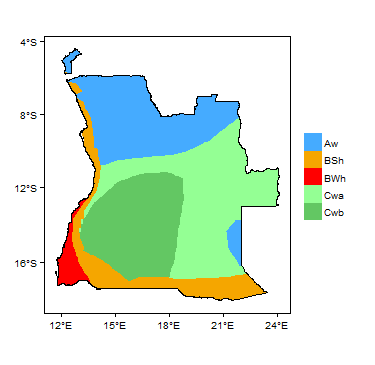 Koppen Geiger Climate Zones
 -
 Average Annual Precipitation
 -
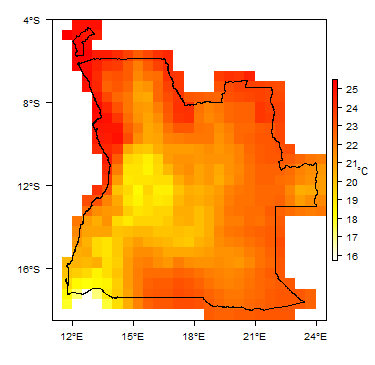 Average Temperature


For further detail on the climate datasets used see the climate resources section.
Surface water
|
|
 |
Soil
 |
Land cover
 |
Geology
This section provides a summary of the geology of Angola. More information is available in the report [ADD LINK UN] (1988) (see References section, below).
The geology map shows a simplified version of the geology at a national scale (see the Geology resources page for more details).

| Key Formations | Period | Lithology | |
| Geological Environment 1 | |||
|---|---|---|---|
| Name of formation1 | Time period | Description | |
| Geological Environment 2 | |||
| Geological Environment 3 | |||
Hydrogeology
This section provides a summary of the hydrogeology of the main aquifers in Angola. More information is available in the report [ADD LINK UN] (1988) (see References section, below).
The hydrogeology map shows a simplified version of the type and productivity of the main aquifers at a national scale (see the Aquifer properties resource page for more details).


Unconsolidated
| Named Aquifers | Period | General Description | Water quality |
Sedimentary - Intergranular Flow
| Named Aquifers | Period | General Description | Water quality |
Sedimentary - Intergranular & Fracture Flow
| Named Aquifers | Period | General Description | Water quality |
Sedimentary - Fracture Flow
| Named Aquifers | Period | General Description | Water quality |
Basement
| Named Aquifers | Period | General Description | Water quality |
Groundwater Status
Groundwater quantity
Groundwater quality
Groundwater use and management
Groundwater use
Groundwater management
Groundwater monitoring
Transboundary aquifers
For further information about transboundary aquifers, please see the Transboundary aquifers resources page
References
The following references provide more information on the geology and hydrogeology of Angola.
These, and others, can be accessed through the Africa Groundwater Literature Archive
United Nations. 1989. Groundwater in Eastern, Central and Southern Africa: Angola. United Nations Department of Technical Cooperation for Development, Natural Resources/Water Series No.19, ST/TCD/6.
Return to the index pages
Africa Groundwater Atlas >> Hydrogeology by country >> Hydrogeology of Angola