Hydrogeology of Chad
Africa Groundwater Atlas >> Hydrogeology by country >> Hydrogeology of Chad
The textual information on this page was taken from a number of reports, which are referenced at the bottom of this page. Some of this information is outdated. If you have more recent information on the hydrogeology of Chad, please get in touch.
Compilers
Dr Kirsty Upton and Brighid Ó Dochartaigh, British Geological Survey, UK
Geographical Setting
The low lying Lake Chad Basin covers much of Chad, with an elevation of about 250 m. There is also low lying land in the dry north of the country. To the north, east and south of the Lake Chad Basin, the land rises gradually to plateaus and mountains. The highest elevations are in the Tibesti massif in the north, at over 3000 m. In the east are plateaus lying at more than 900 m (United Nations 1988).

General
| Estimated Population in 2013* | 12,825,314 |
| Rural Population (% of total) (2013)* | 77.8% |
| Total Surface Area* | 1,259,200 sq km |
| Agricultural Land (% of total area) (2012)* | 39.7% |
| Capital City | N'Djamena |
| Region | Central Africa |
| Border Countries | Niger, Libya, Egypt, Sudan, Central African Republic, Cameroon, Nigeria |
| Annual Freshwater Withdrawal (2013)* | 879.6 Million cubic metres |
| Annual Freshwater Withdrawal for Agriculture (2013)* | 76.4% |
| Annual Freshwater Withdrawal for Domestic Use (2013)* | 11.8% |
| Annual Freshwater Withdrawal for Industry (2013)* | 11.8% |
| Rural Population with Access to Improved Water Source (2012)* | 44.8% |
| Urban Population with Access to Improved Water Source (2012)* | 71.8% |
* Source: World Bank
Climate
Chad has a varied climate. In the south, rainfall is high - an annual average of 1000 to 1400 mm. In the central zone, average annual rainfall is between 700 and 1000 mm. In the north, the climate is semi-arid, with average annual rainfall between 200 and 700 mm. The far north is arid, with total annual rainfall below 500 mm. The dry northern zones have high evaporation of around 2200 to 2300 mm (United Nations 1988).
-
 Koppen Geiger Climate Zones
 -
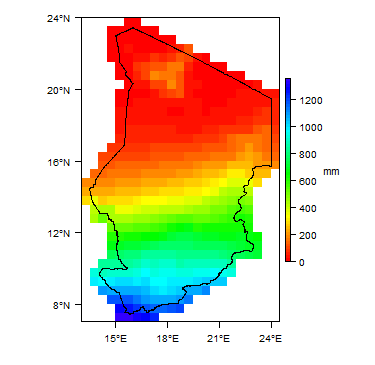 Average Annual Precipitation
 -
 Average Temperature


For further detail on the climate datasets used see the climate resources section.
Surface water
| Southern Chad is drained by two main perennial rivers: the Chari and its largest tributuary the Logone, both of which receive flow mainly from tributaries from outside the country. The Chari river drains into Lake Chad, which is the largest surface water resource in the country. The Lake Chad basin is one of the best studied in Africa, and is shared by a number of countries, including Chad, Niger, Nigeria and Cameroon. As well as the Chari river, it is fed by two other smaller rivers flowing from Nigeria and Cameroon.
In the central and northern parts of the country, all the rivers are ephemeral, generally flowing only for a few hours after heavy rain, or at most for a few months each year (United Nations 1988). |
 |
Soil
 |
Land cover
| Land cover in Chad is largely controlled by climate. In the wetter southern zone, arable crops are and forest are widespread. In the central zone, arable crops and forest become rarer and land cover becomes dominated by grassland and savanna. In the dry north, vegetation is scarce (United Nations 1988). |  |
Geology
This section provides a summary of the geology of Chad. More information is available in the report ‘Groundwater in North and West Africa: Chad’ (1988) (see References section, below).
The geology map shows a simplified version of the geology at a national scale (see the Geology resources page for more details).

Summary
The geology of Chad is dominated by the Lake Chad Basin, a sedimentary basin formed in the Mesozoic era and infilled with older Tertiary Continental Terminal sandstones and argillaceous sands, and younger Pliocene-Quaternary sandy/clayey deltaic and lacustrine deposits (Ngatcha et al. 2008, UNICEF 2010).
To the north and east of the Lake Chad Basin are older rocks, including Cretaceous continental and marine sedimentary rocks; Palaeozoic sedimentary rocks, largely sandstones; and Precambrian metamorphic and crystalline basement rocks.
| Key Formations | Period | Lithology | |
| Quaternary | |||
|---|---|---|---|
| Quaternary | Quaternary formations occur across most of the Chad basin and are dominated by lacustrine deposits. However, lithology was controlled by the climate during deposition, with wet periods favouring the deposition of clays and diatomites; periods of alternating wet and dry seasons tending to produce sandy deltaic deposits; and dry periods favouring the formation of aeolian sand dunes. The deposits therefore range from pure sand to clayey sand, and include some kaolinitic clays. Abrupt changes in clay and sand content are common, and the sediments usually occur as overlapping lenses. | ||
| Tertiary | |||
| Continental Terminal; also small area of Eocene marine deposits in northern Tibesti | Eocene, Oligo-Miocene, Neogene, | The Oligo-Miocene to Neogene Continental Terminal formation occurs across large parts of southern Chad, in the Lake Chad Basin, and consists of alternating sandstone, argillaceous sand and clay layers. They are generally at depths of 400 to 700 m, covered by Quaternary and Pliocene deposits. The upper part of the series is a lacustrine sequence of Neogene age called the Chad Formation. | |
| Cretaceous | The Lower Cretaceous in Chad is characterized by continental clastic sequences and the Upper Cretaceous includes up to 400 m thick marine sedimentary rocks. These rocks are present at depth in the Lake Chad Basin, and crop out at the surface in parts of the centre and north of the country. | ||
| Palaeozoic sedimentary | |||
| Cambro-Ordovician, Devonian and Carboniferous | Lower Palaeozoic sandstone sequences in the Kufra Basin in the northeast (along the border with Libya and Sudan). | ||
| Precambrian Basement | |||
| Precambrian | Granitic and crystalline rocks of the Tibesti and Ouaddai in the north; and the Lam mountains in the south | ||
Hydrogeology
This section provides a summary of the hydrogeology of the main aquifers in Chad. More information is available in the report ‘Groundwater in North and West Africa: Chad’ (1988) (see References section, below).
The hydrogeology map shows a simplified version of the type and productivity of the main aquifers at a national scale (see the Aquifer properties resource page for more details). A digital map of hydrogeological units is held by the Direction Nationale de l’Hydraulique (UNICEF 2010).
An older but higher resolution hydrogeological map at 1:500,000 scale was published in 1969 by BRGM and a copy can be viewed on the WHYMAP site.


Summary
The Lake Chad Basin in southern Chad is one of the largest sedimentary groundwater basins in Africa. It includes three main aquifers: an upper, unconsolidated Quaternary/Pliocene aquifer of lacustrine and deltaic deposits; the underlying Tertiary Continental Terminal sequence; and a lower aquifer of Cretaceous age, which is less well understood.
Smaller outcrops of unconsolidated Quaternary deposits, largely alluvium in river valleys, also occur in other parts of the country overlying bedrock.
Cretaceous sedimentary rocks...
Palaeozoic sedimentary rocks...
Precambrian basement rocks crop out in eastern Chad and in the northwestern part.
Unconsolidated
| Named Aquifers | Period | General Description | Water quality |
| Koros aquifers (south Chad); 'sanies' aquifer (northern Bastra); Chari-Baguirmi aquifer; shallow 'Oudian' aquifer (Kanem) | Quaternary | The Koros aquifer comprises permeable sands that receive recharge partly from infiltration of river flows in the alluvial valleys, but largely from direct rainfall infiltration.
The Chari-Baguirmi aquifer comprises a succession of clay-sand formations dotted with small higher area of sand dunes, and areas of clay depressions. The average depth of the top of the aquifer is 35 to 40 m, but this rises to about 20 m in the northwest and west, closer to Lake Chad and the Chari river. The Kanem aquifer comprises permeable sands, which receive most recharge by infiltration from Lake Chad at the southern edge of the aquifer, but is also recharged from direct rainfall infiltration. In the northern part of Kanem, studies have shown high recharge from the slopes of the Tibesti and Ennedi uplands. The shallow Quaternary aquifer within the Lake Chad basin consists of sandy, deltaic and lacustrine deposits that are present at depths of up to at least 50 m. It is unconfined and in direct hydraulic contact with the Logone-Chari river system and with Lake Chad. Groundwater is abstracted for domestic use and livestock watering through hand dug wells and boreholes.
|
Groundwater in parts of the Kanem aquifer contains high concentrations of sodium carbonates and sodium sulphates.
In the Lake Chad basin Quaternary aquifer there are high nitrate concentrations linked to agriculture discharges and faecal contamination. |
Sedimentary - Intergranular Flow
| Named Aquifers | Period | General Description | Water quality |
| Continental Terminal, Lake Chad Basin | Tertiary | The alternating sandstones and clay rich bands of the Continental Terminal underlie the Quaternary aquifer of the Lake Chad Basin, sometimes at depths of up to 400 to 600 m. It is artesian, confined by overlying clay bands. Groundwater is abstracted for drinking water in rural and urban areas, but extraction costs are considerable. |
Sedimentary - Intergranular & Fracture Flow
| Named Aquifers | Period | General Description | Water quality |
Sedimentary - Fracture Flow
| Named Aquifers | Period | General Description | Water quality |
Basement
| Named Aquifers | Period | General Description | Water quality |
| Weathered basement, often in hydraulic continuity with overlying Quaternary alluvial sands | Precambrian | In deep valleys in the granitic massifs, the upper parts of the Precambrian rocks can be heavily weathered. These weathered basins form low to moderate productivity aquifers, especially where they are in hydraulic continuity with overlying permeable Quaternary sands, which supply additional groundwater storage. |
Groundwater Status
Groundwater quantity
Groundwater quality
Groundwater use and management
Groundwater use
Groundwater management
Groundwater monitoring
Transboundary aquifers
For further information about transboundary aquifers, please see the Transboundary aquifers resources page
References
The following references provide more information on the geology and hydrogeology of Chad.
These, and others, can be accessed through the Africa Groundwater Literature Archive
Alker M. 2008. The Lake Chad Basin Aquifer System: a case study for the research project 'Transboundary groundwater management in Africa'. German Development Institute
GWP (Global Water Partnership). 2013. The Lake Chad Basin Aquifer System. Global Water Partnership Transboundary Groundwater Fact Sheet, compiled by F Bontemps.
Ngatcha BN, Mudry J and Leduc C. 2008. The state of understanding on groundwater recharge for the sustainable management of transboundary aquifer in the Lake Chad Basin. Presentation at 4th International Symposium on Transboundary Water Management, Thessaloniki, Greece, 15-18 October 2008
Scheider JL and Wolff JP. 1969. Carte Hydrogeologique de la Republique du Tchad; Scale 1:500 000. Bureau de Recherches Geologiques et Minieres (BRGM), Orleans.
United Nations. 1988. Groundwater in North and West Africa: Chad. United Nations Department of Technical Cooperation for Development and Economic Commission for Africa, Natural Resources/Water Series No. 18, ST/TCD/5.
UNICEF. 2010. Republic of Chad: feasibility study for manual drilling: mapping of favourable zones. Ministere de l'Environnement, de l'Eau et des Ressources Halieutiques. Practica/Enterprise Works/VITA/UNICEF
Return to the index pages
Africa Groundwater Atlas >> Hydrogeology by country >> Hydrogeology of Chad